Pregnancy Week 5: The Miracle of the First Pulse
Welcome to Week 5! This is the most biologically intensive week of your first trimester. Your baby has officially transitioned from a ball of cells into an Embryo, measuring roughly the size of an orange seed (3mm). While your body is outwardly the same, an incredible feat of engineering is occurring within: a tiny tube is beginning to pulse, marking the very first beat of your baby's heart.
This week is defined by the "Great Organization." Your baby is no longer growing randomly; the cells are now organizing into a distinct head, tail, and torso. We will explore the three critical systems forming today: the circulatory system, the central nervous system, and the primary life-support structures.
Clinical Phase: Early Embryonic Period
Crown-Rump Length: 2mm - 4mm (Apple Seed size)
Primary Milestone: Cardiac Tube Pulsation
Hormonal Status: hCG doubling every 48-72 hours
Section 1: The Heart — Building the First Engine
A major "Content Gap" in most pregnancy guides is the over-simplification of the heart. In Week 5, the heart does not yet have chambers or valves. Instead, it begins as two separate vessels that fuse together to form a primitive heart tube. This tube is the first functioning organ in the human body.
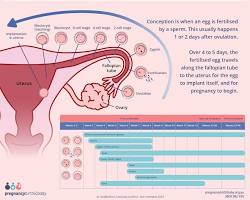
Cardiac Looping: The heart tube begins to fold into an 'S' shape to eventually form the four chambers.
By Day 22 or 23, the cells in this tube begin to contract spontaneously. This is not yet a heartbeat you can hear, but it is a "flicker" that can often be seen on high-resolution transvaginal ultrasounds. This pulse is vital because it begins circulating the baby's first red blood cells, which are being produced by the yolk sac to deliver oxygen to the rapidly growing brain.
Section 2: The Neural Tube — Zipping the Blueprint
While your baby’s heart starts to beat, their brain and spinal cord are undergoing a high-stakes process called neurulation. The flat layer of cells on the embryo's back folds inward to form a groove. This week, the edges of that groove must meet and fuse together like a zipper.
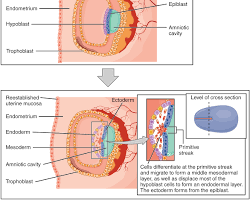
Biological Fusion: The neural tube "zips" shut from the center toward the ends, protecting the central nervous system.
This "zipping" process is the reason why **Folic Acid** is critical. It acts as the molecular glue that helps these cells fuse. If the tube does not close completely at the top, it affects brain development; if it doesn't close at the bottom, it can result in Spina Bifida. By the end of this week, the foundation of your baby’s entire personality, movements, and thoughts is being permanently sealed into place.
Section 3: The 5-Week Ultrasound — Managing Expectations
Many mothers have their first scan in Week 5 and leave feeling anxious because the doctor saw an "empty sac". Giant competitors fail to explain that this is mathematically normal. In Week 5, the embryo is smaller than a grain of rice and is often hidden against the wall of the gestational sac.
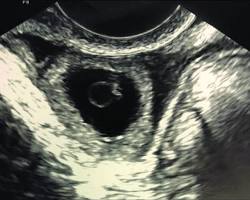
The Early Window: Seeing the yolk sac is the first confirmation that the pregnancy is developing inside the uterus.
The Yolk Sac is the first structure to appear inside the dark gestational sac. It provides all the nutrients the embryo needs until the placenta is fully functional in the second trimester. Seeing the yolk sac this week is a huge milestone, as it confirms the pregnancy is in the correct location.
Section 4: Symptoms — The Chemical Storm
The symptoms you feel this week are the direct result of your body diverting massive amounts of energy to the uterus.
| Symptom | The Biological Reason | Management Tip |
|---|---|---|
| Morning Sickness | The rapid rise of hCG irritates the stomach and the brain's nausea center. | Eat small, protein-rich snacks every 2 hours to keep blood sugar stable. |
| Frequent Urination | Increased blood volume means your kidneys are processing more fluid. | Lean forward while urinating to ensure you fully empty your bladder. |
| Extreme Fatigue | Your body is building the placenta, which consumes immense energy. | Listen to your body; a 20-minute nap is a biological necessity right now. |
Section 5: Action Plan — The First Positive Steps
Section 6: 5 Deep-Dive FAQs (Expert Reassurance)
My hCG level is 500 mIU/ml, but my friend's was 2,000 at 5 weeks. Is something wrong?
No. The "normal" range for hCG in Week 5 is incredibly wide, spanning from 18 to 7,340 mIU/ml. Because every woman ovulates and implants on a different schedule, the absolute number matters much less than the doubling rate. Doctors look for your levels to increase by at least 60% every 48 hours to confirm the pregnancy is progressing.
I saw a "flicker" on the scan but didn't hear a heartbeat. Why?
It is physically impossible to "hear" the heartbeat with a Doppler in Week 5. The heart is currently a microscopic tube pulsing at about 100-120 beats per minute. While an ultrasound can see the visual motion of the pulse, the heart doesn't yet have the hard valves required to create the "lub-dub" sound waves that audio equipment picks up. You will likely hear it for the first time around Week 9.
Why am I having mild cramping? Is it a sign of miscarriage?
Mild, period-like cramping is extremely common in Week 5. It is often caused by the embryo burrowing deeper into the nutrient-rich uterine lining and the uterus beginning to stretch to accommodate the gestational sac. As long as the cramping is not accompanied by heavy red bleeding or severe, one-sided pain, it is considered a normal part of early development.
What is a "Chemical Pregnancy" and am I still at risk?
A chemical pregnancy is a very early miscarriage that occurs shortly after implantation. It is called "chemical" because it is only detected by a pregnancy test (hCG), not yet on an ultrasound. Most occur due to chromosomal issues that prevent the embryo from growing. Once a Yolk Sac is visible on an ultrasound (usually by the end of Week 5), the statistical risk of a chemical pregnancy drops significantly.
Can high heat or fevers really hurt the baby this week?
Yes. Week 5 is the "Critical Window" for neural tube closure. Research shows that high maternal core temperatures (from saunas, hot tubs, or fevers over 102°F) can interfere with the proteins needed for the neural tube to zip shut. If you develop a fever this week, contact your doctor immediately to discuss pregnancy-safe ways to lower your temperature.
Essential Tools for Week 5
👉 Calculate your official Due Date
👉 See the full First Trimester directory
Medical Disclaimer: This content is for informational purposes only. It is not intended to provide medical advice or to take the place of treatment from a physician.